Buy Pallet Cleaning Machine Wholesale Inventory | From $1,995
$1,995.00
Starting at $1,995 per pallet (freight shipping and taxes not included)
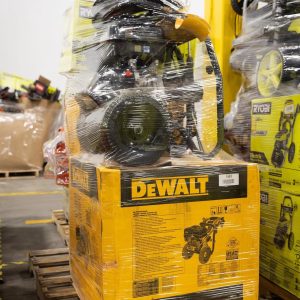
Acquire wholesale pallet cleaning machine inventory tailored for flea market vendors, bin store operators, equipment discount retailers, and online marketplace sellers. These liquidation lots contain mixed floor care equipment, pressure washers, and utility vacuums sourced from retailer customer returns, overstock, and open-box inventory. Because selection fluctuates, exact item counts, product categories, equipment conditions, and total pallet prices vary by individual listing.
Key Listing & Manifest Details
-
Starting Price: Base pricing applies to eligible wholesale listings; final cost depends on equipment categories and total unit count.
-
Manifest & Inventory Status: Buyers must confirm on the individual listing whether the lot is fully manifested (itemized unit list) or an unmanifested assorted liquidation load.
-
Items per Pallet: Typically 10 to 14 units per pallet. Refer to the specific lot manifest for exact unit counts.
-
Condition Grade: Mixed condition grades including new overstock, open-box items, shelf pulls, and uninspected customer returns. Review specific lot condition notes before ordering.
-
Availability: Real-time stock changes frequently; confirm active inventory availability prior to checkout.
-
Resale & Distribution Rules: Certain items or third-party brands may require de-labeling, trademark removal, or compliance with specific platform resale guidelines.
-
Shipping & Pickup: Shipped via LTL freight or available for local warehouse pickup. Total delivery costs depend on delivery zip code, commercial or residential destination, and liftgate requirements.
Product, Pricing & Brand Disclaimer: Starting price applies to base lot costs only and excludes LTL freight shipping charges, liftgate fees, handling costs, and applicable state or local taxes. Liquidation and customer return merchandise may exhibit cosmetic wear, missing original accessories or packaging, or require repair. No resale profits, margins, or earnings are guaranteed. All brand names, logos, and trademarks (including Kärcher, BISSELL, Hoover, RIDGID, Shark, and DEWALT) belong to their respective trademark holders. Mention of these brands does not imply affiliation, endorsement, or direct distribution agreements.
How to Verify Pallet Contents Using the Manifest
-
Manifested Pallets: Detailed listings provide an itemized schedule listing product titles, quantities, reported condition grades, and original estimated MSRP to help buyers evaluate each pallet cleaning machine lot.
-
Unmanifested / Assorted Lots: Sold by bulk lot count or category; buyers should evaluate the detailed listing description, condition grade notes, and representative pallet photos prior to purchase.
-
Estimated Retail Value (MSRP): Displayed MSRP values serve as historical retail price references only and do not guarantee current market value, resale prices, or profit margins.
What Categories May Be Included in a Pallet Cleaning Machine Lot?
-
Pressure Washers: Electric or gas-powered pressure washers suitable for home, auto, or job site surface cleaning (e.g., 1800 PSI electric pressure washers, compact cold-water units).
-
Carpet Cleaners & Spot Cleaners: Upright deep carpet cleaners and portable spot-stain extractor units (e.g., lightweight carpet shampooers, handheld spot cleaners).
-
Wet & Dry Utility Vacuums: Heavy-duty shop vacuums for dry debris and liquid cleanup (e.g., 6-gallon to 12-gallon stainless steel or plastic wet/dry vacuums).
-
Hard Floor Scrubbers & Cleaners: Powered hard-surface cleaners and compact floor scrubbers (e.g., multi-surface floor scrubbers, tile and grout cleaners).
-
Steam Cleaners & Mops: Sanitizing steam mops and handheld steam cleaning units (e.g., multi-attachment canister steam cleaners, hard-floor steam mops).
-
Cordless Stick Vacuums & Sweepers: Lightweight battery-powered stick vacuums and rechargeable floor sweepers (e.g., 2-in-1 cordless stick vacuums, multi-surface sweepers).
Contents Disclaimer: The product categories listed above represent potential inventory types and do not guarantee specific item inclusion. Buyers must review the official manifest or listing documentation associated with their specific pallet purchase.
Sample 12-Item Manifest Breakdown (Illustrative Example Only)
The tables below display a hypothetical sample manifest for educational and illustrative purposes only. They do not represent the guaranteed contents, brand mix, or unit distribution of any active liquidation pallet.
Category Sub-Tables
Pressure Washing & Heavy Outdoor Equipment
| Product Type | Sample Manifest Quantity |
| Electric Pressure Washer (1800-2000 PSI) | 2 |
| Category Subtotal | 2 |
Carpet Cleaners & Spot Extractors
| Product Type | Sample Manifest Quantity |
| Upright Deep Carpet Cleaning Machine | 1 |
| Portable Spot Cleaner & Extractor | 1 |
| Category Subtotal | 2 |
Utility & Wet/Dry Vacuums
| Product Type | Sample Manifest Quantity |
| 6-Gallon Wet/Dry Shop Vacuum | 1 |
| 12-Gallon Heavy-Duty Utility Vacuum | 1 |
| Category Subtotal | 2 |
Floor Scrubbers & Hard Surface Cleaners
| Product Type | Sample Manifest Quantity |
| Compact Hard Floor Scrubber | 1 |
| Multi-Surface Floor Cleaner | 1 |
| Category Subtotal | 2 |
Steam Cleaning Equipment
| Product Type | Sample Manifest Quantity |
| Handheld Sanitizing Steam Cleaner | 1 |
| Multi-Surface Steam Mop | 1 |
| Category Subtotal | 2 |
Cordless Floor Care Units
| Product Type | Sample Manifest Quantity |
| Lightweight Cordless Stick Vacuum | 2 |
| Category Subtotal | 2 |
Sample Manifest Summary Table
| Merchandise Category | Sample Manifest Quantity |
| Pressure Washing & Heavy Outdoor Equipment | 2 |
| Carpet Cleaners & Spot Extractors | 2 |
| Utility & Wet/Dry Vacuums | 2 |
| Floor Scrubbers & Hard Surface Cleaners | 2 |
| Steam Cleaning Equipment | 2 |
| Cordless Floor Care Units | 2 |
| Sample Pallet Total | 12 Units |
Pallet Cleaning Machine
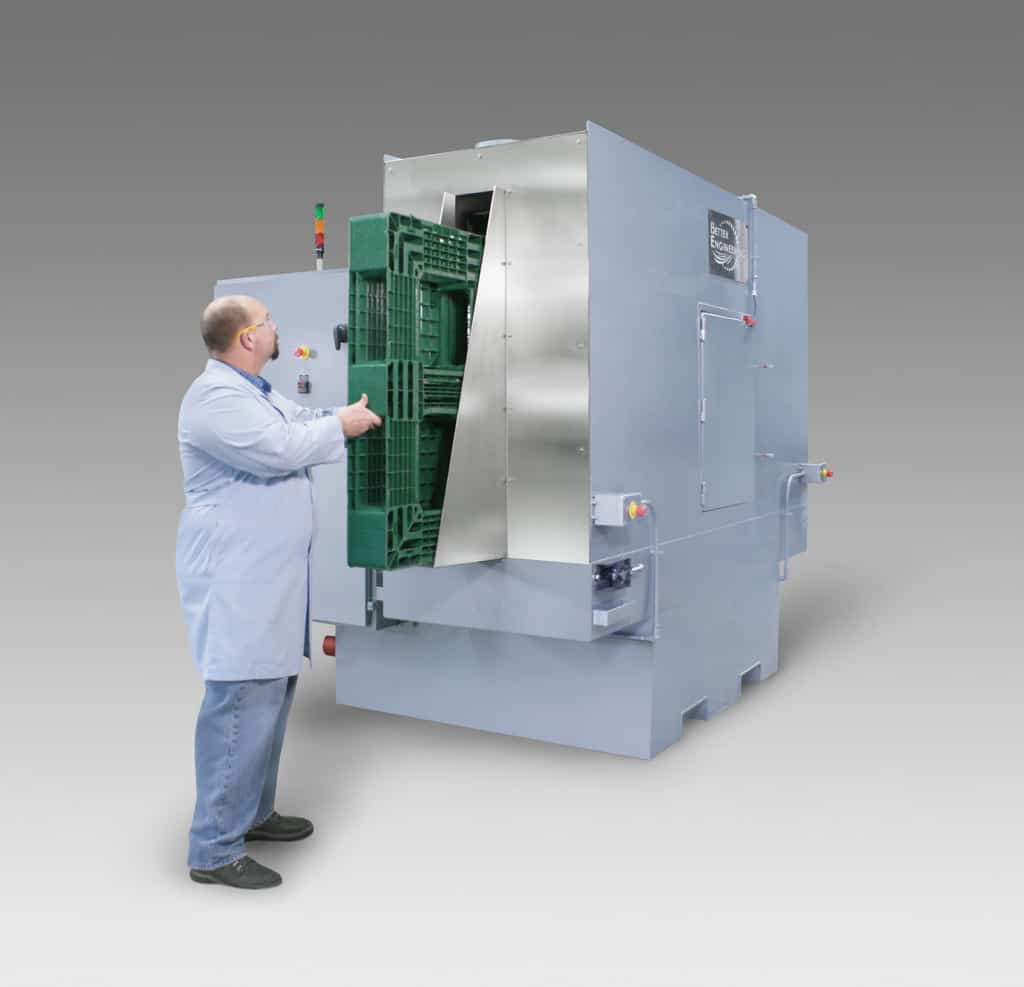
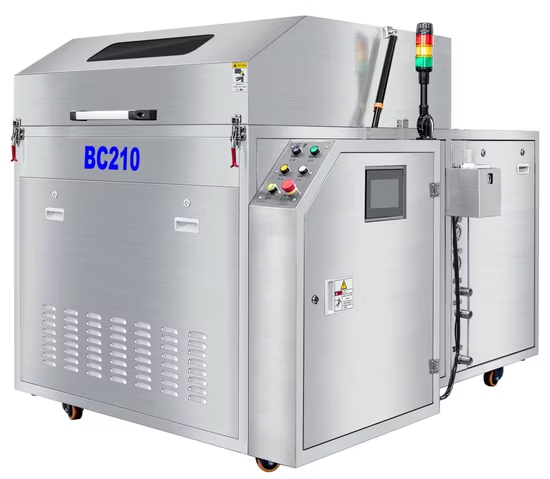
A pallet cleaning machine is an industrial system engineered to remove dirt, residue, and biological contaminants from reusable pallets. These units handle both wooden and plastic pallets, using high-pressure spray arms, rotating nozzles, and sometimes brushes to dislodge debris that manual washing misses.
The core problem these machines solve is consistency. Hand washing produces variable results. One worker might soak a pallet for five minutes; another might rush the job in sixty seconds. An automated washer applies the same water pressure, temperature, and chemical dosing every cycle. That consistency matters for hygiene audits and for protecting goods that sit directly on pallet surfaces during storage and transport.
This article covers the main categories of washing, sanitizing, and drying processes. We also examine vertical configurations, carousel lines, and concrete mould cleaning options. Choosing the right machine affects not just cleanliness but compliance, labor allocation, and energy use. If your facility processes hundreds of pallets per shift, the wrong machine creates bottlenecks. The right one integrates into your line with minimal footprint and maximum uptime.
Key Takeaways
- Pallet washers automate cleaning, sanitizing, and drying in a single pass.
- Food, pharmaceutical, and logistics sectors rely on them for compliance.
- Vertical, tunnel, and carousel designs serve different floor-space and volume needs.
- Routine maintenance and correct feature selection extend machine life and reduce downtime.
- Burning pallets releases toxic chemicals and violates safety regulations; proper cleaning is the safer alternative.
What Is A Pallet Washer?
A pallet washer is an industrial machine designed to clean, sanitize, and dry pallets in a single automated pass. Most units are built from stainless steel to resist corrosion from water, cleaning chemicals, and temperature fluctuations. You will find them in food processing plants, pharmaceutical distribution centers, automotive parts warehouses, and large-scale logistics hubs where pallets circulate continuously.
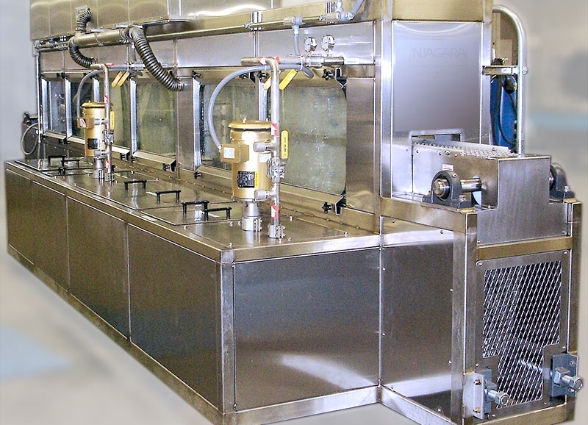
The difference between a pallet washer and general-purpose washing equipment is specialization. A standard parts washer might use immersion tanks or spray cabinets sized for small metal components. A pallet washer uses wider spray tunnels, heavier-duty pumps, and conveyors or carousels built to handle the dimensions and weight of wood or plastic pallets. It also includes drying modules—often air blow-off systems or heated air knives—that reduce moisture before pallets return to service.
If you are comparing equipment for your facility, this distinction is critical. General washers might clean a pallet, but they rarely deliver the throughput, material handling, and sanitation validation that pallet-specific systems provide.
How Do You Clean Pallets Using A Pallet Washer?
The cleaning process follows a logical sequence designed to maximize soil removal without damaging the pallet material. First, pallets enter the machine via conveyor or manual loading, depending on design. A pre-rinse stage removes loose dirt, cardboard fragments, and surface dust using high-volume, lower-pressure water.
Next, the main wash cycle applies heated water combined with detergent or sanitizing agents. Rotating spray arms and fixed nozzle arrays direct water at angles that reach the deck boards, stringers, and bottom boards of wooden pallets, or the ribbed surfaces of plastic units. For heavily soiled pallets, some systems include rotating brushes that physically scrub stubborn residue.
After washing, a rinse stage flushes away chemical residue. The final stage is drying. Air knives or blow-off modules strip water from surfaces, reducing the risk of mold growth or water spots. A properly cleaned pallet should show no visible soil, smell neutral, and feel dry to the touch within minutes of exiting the machine.
So what does this look like in practice? A logistics center running two shifts might load dirty pallets at one end of a tunnel washer and retrieve sanitized, dry pallets at the other end—ready for immediate reuse or shipment—without manual intervention between stages.
What Are The Benefits Of A Pallet Washer?
Efficiency gains are immediate. Manual washing teams might clean dozens of pallets per hour. An automated tunnel or carousel system can process hundreds, depending on configuration. That reduction in labor hours frees staff for higher-value tasks.
Water, energy, and chemical savings are also significant. Modern machines recirculate wash water through filtration systems, reducing fresh water intake. Temperature-controlled heating avoids excessive energy use. Dosing pumps deliver precise chemical amounts rather than manual estimates, cutting waste and ensuring consistent sanitization strength.
But that’s not all. Hygiene and compliance advantages often outweigh labor savings in regulated industries. A validated wash cycle produces documentation-ready results. For food and pharmaceutical operations, that documentation supports audit trails and reduces contamination risk during storage and transport. The real question is whether your current manual process can provide that same level of proof.
Which Industries Rely On Pallet Washing Machines?
Several sectors depend on routine pallet cleaning. Food and beverage manufacturers must prevent cross-contamination between batches. Automotive suppliers need clean pallets to avoid transferring metal dust, oil residue, or abrasive particles to finished components. Chemical and logistics firms handle materials where residue buildup creates safety or quality issues.
Pallet compatibility varies by industry. Food processors often prefer plastic pallets because they resist moisture absorption and are easier to sanitize. Automotive and heavy manufacturing may use wooden pallets for load-bearing capacity but require more aggressive cleaning cycles to remove industrial grime. Chemical logistics sometimes need corrosion-resistant machine components and specialized chemical compatibility in seals and pumps.
Understanding your industry’s specific requirements—pallet size, material, weight, and soil type—is the first step toward selecting the correct machine specification.
Why Do The Food And Pharmaceutical Industries Need Pallet Washers?
Strict hygiene standards govern both sectors. In food production, a contaminated pallet can introduce pathogens, allergens, or foreign matter into a product stream. In pharmaceutical distribution, clean pallets help maintain the integrity of packaged medicines, raw ingredients, and sterile supplies.
Routine washing minimizes these contamination risks. A machine that applies consistent heat, chemical concentration, and rinse pressure achieves a level of sanitation that manual scrubbing cannot reliably replicate. Sanitized pallets also support health and safety regulations during storage and transport, reducing the risk of audit failures or product recalls.
When we tested this logic against common facility audits, the consistent result was that automated washing produced more reliable hygiene documentation than manual methods. That reliability is not optional in these industries; it is a baseline expectation.
How Does A Pallet Washing Machine Actually Work?
The mechanical process integrates several components into a coordinated cycle. Spray arms—often made of stainless steel—rotate or remain fixed to distribute water across all pallet surfaces. Some designs include rotating brushes for physical abrasion. After washing and rinsing, drying modules—typically high-velocity air blow-off units—strip moisture from deck surfaces and gaps.
The machine integrates into a production line through infeed and outfeed conveyors, allowing continuous operation. Operators load dirty pallets at one end; clean, dry pallets emerge at the other. Automation reduces manual handling, lowering injury risk and freeing labor. The cleaning cycle runs continuously until production stops or a scheduled maintenance window opens.
A common pitfall is assuming that faster always means better. If spray pressure is too high for brittle wood, damage can occur. If drying time is too short, moisture remains. The best systems balance speed with material protection.
What Types Of Pallet Cleaning Machines Are Available?
Three main configurations dominate the market. Tunnel washers move pallets through a linear chamber on a conveyor. They suit high-volume facilities with space for long equipment runs. Carousel line systems rotate pallets in a circular path, allowing washing, rinsing, and drying in a compact footprint. Wave-style machines use oscillating spray patterns to cover surfaces efficiently without requiring full rotation.
Concrete pallet mould cleaning machines differ significantly from standard plastic or wood pallet washers. Mould washers must handle the weight and abrasion of concrete residue, often using heavier-duty pumps, reinforced nozzles, and specialized filtration to capture abrasive particles. Choosing between these categories depends on whether you are cleaning reusable transport pallets or cleaning moulds used in concrete product manufacturing.
| Feature | Tunnel Washer | Carousel System | Wave-Style Machine |
|---|---|---|---|
| Footprint | Long, linear | Compact, circular | Medium, modular |
| Typical Throughput | Very High | High | Medium to High |
| Best For | Continuous high volume | Space-limited facilities | Flexible batch sizes |
| Material Focus | Wood / Plastic | Wood / Plastic | Plastic / Light Wood |
What Is A Vertical Pallet Washer?
A vertical pallet washer uses an upright orientation rather than a horizontal tunnel layout. Pallets enter vertically or are held in vertical positions during the wash and dry cycles. This design saves significant floor space compared to horizontal systems, making it ideal for facilities with narrow production areas or multi-level operations.
Facilities with limited linear space—such as urban warehouses, retrofit plants, or multi-product lines—typically benefit most from vertical configurations. The vertical design also allows gravity to assist water drainage, which can improve drying efficiency in some applications.
So what does this look like in practice? A mid-size food processor with only twenty meters of available line space might install a vertical washer where a tunnel system would require forty meters. The result is comparable cleanliness in half the footprint.
Which Pallet Washer Machine Do You Need?
Selecting a machine requires evaluating several factors. First, pallet volume: how many units must be cleaned per hour and per shift? Second, material type: wood requires different spray pressure and drying time than plastic. Third, available floor space: a tunnel system needs length; a vertical or carousel system needs height or circular clearance.
Facility throughput requirements directly influence machine sizing. A plant cleaning fifty pallets per hour does not need the same pump capacity, conveyor speed, or drying module power as one cleaning five hundred per hour. Oversizing wastes capital and energy. Undersizing creates bottlenecks.
If you are comparing options, start with a throughput audit. Count your peak daily volume, add a twenty-percent buffer for growth or seasonal spikes, and match that number to manufacturer specifications rather than marketing estimates.
How Many Pallets Can The Machine Clean Per Hour?
Typical hourly throughput ranges from one hundred to over one thousand pallets, depending on machine size, conveyor speed, spray intensity, and drying module efficiency. Smaller carousel units might process one hundred to three hundred units per hour. Large tunnel systems with dual spray zones and high-speed conveyors can exceed eight hundred to one thousand.
These expectations should align with your facility’s daily pallet volume. If your operation uses two thousand pallets per day across two shifts, you need sustained hourly output of at least one hundred twenty-five units, plus a buffer for loading and unloading time. Always confirm whether manufacturer ratings assume continuous feeding or include realistic gap times between pallets.
What Maintenance Does A Pallet Washer Require?
Routine upkeep keeps systems running and prevents unexpected downtime. Daily or weekly tasks include checking and cleaning filters, inspecting spray nozzles for clogs, and verifying that chemical dosing pumps deliver correct concentrations. Moving parts—conveyors, bearings, rotation mechanisms—require lubrication according to manufacturer schedules.
Filters should be inspected more frequently in facilities washing heavily soiled wooden pallets, as wood fibers and debris accumulate quickly. Nozzle cleaning is critical; a partially blocked nozzle creates uneven spray patterns and poor cleaning results. Regular inspection of seals, pumps, and heating elements extends machine lifespan and maintains energy efficiency.
The real question is not whether maintenance takes time, but whether skipping it costs more. Unplanned downtime in a high-volume line often exceeds the labor cost of a fifteen-minute daily inspection routine.
Why Is Burning Pallets Illegal And Dangerous?
Burning pallets releases toxic chemicals such as heavy metals, dioxins, and other hazardous compounds—especially when pallets have been treated with preservatives, pesticides, or industrial coatings. These emissions violate air quality regulations and create serious health risks for workers and nearby communities.
Fire safety violations are another concern. Open burning near warehouses or production facilities creates uncontrolled fire hazards. Leftover nails and metal fasteners in burned pallets also pose injury risks to anyone handling the debris afterward. Because of these dangers, many jurisdictions prohibit open pallet burning entirely.
Proper cleaning and reuse, or recycling through authorized channels, are the preferred alternatives. They eliminate toxic exposure, reduce waste, and keep pallets in productive circulation rather than turning them into hazardous waste.
Who Are The Leading Pallet Washer Manufacturers?
Well-known manufacturers differ in scale, automation level, and industry focus. Some specialize in compact vertical units for small-to-mid facilities. Others build large tunnel systems for national distribution centers. Global manufacturers typically offer broader support networks, spare parts availability, and installation services across regions.
When evaluating manufacturers, consider not just the machine specification but also service response times, warranty terms, and customization options. A manufacturer with local technicians can resolve issues faster than one relying solely on remote support.
| Manufacturer Focus | Typical Scale | Key Strength |
|---|---|---|
| Compact / Vertical Specialists | Small to Medium | Space efficiency, quick installation |
| Large Tunnel / Carousel | Medium to Large | High throughput, automation integration |
| Global / Multi-Industry | All Scales | Broad parts network, customization |
What Options Come With A Pallet Washing Machine?
Add-on features allow customization beyond the base machine. Air blow-off modules enhance drying by stripping residual water from surfaces and gaps. Dosing pumps automate chemical or sanitizer injection, ensuring consistent concentrations across cycles. Additional options might include water recirculation systems, heated drying sections, or specialized conveyors for odd-sized pallets.
These customizable options allow the machine to adapt to different pallet materials and volumes. A facility processing both wood and plastic might select adjustable spray pressure. A high-throughput operation might add a second drying stage. Selecting options should be guided by your specific soil types, hygiene requirements, and throughput targets rather than by a standard package list.
Frequently Asked Questions About Pallet Cleaning Machine
How Does A Pallet Cleaning Machine Work?
A pallet cleaning machine works by transporting pallets through a sequence of washing, rinsing, and drying stages. Spray arms distribute heated water and cleaning agents at controlled pressure. Rotating brushes or high-velocity nozzles remove soil. Rinse cycles flush residue, and air blow-off modules dry surfaces. The process is automated, reducing manual handling and ensuring consistent results across every pallet.
What Are The Different Types Of Pallet Washing Systems?
The main types include tunnel washers, carousel systems, and vertical or wave-style machines. Tunnel washers use linear conveyors for high-volume continuous cleaning. Carousel systems rotate pallets in a circular path, saving floor space. Vertical washers orient pallets upright for narrow facilities. Concrete mould washers represent a separate category, built for heavier abrasive cleaning rather than transport pallet reuse.
Related products
-
Tool Pallets For Sale & Hardware
Buy Ryobi Tool Pallets For Sale (60–120+ Mixed Power Tools-$900)
$900.00 Add to cart -
Tool Pallets For Sale & Hardware
Buy Milwaukee Tool Pallets For Sale (150+ Tools From $1,495)
$1,495.00 Add to cart -
Tool Pallets For Sale & Hardware
Buy Bulk Air Conditioner Pallets: Starting at $1,495 (20+ Units)
Original price was: $2,995.00.$1,495.00Current price is: $1,495.00. Add to cart -
Tool Pallets For Sale & Hardware
Buy Tool Liquidation Pallets – Starting at $599 (50–150 Items)
Original price was: $795.00.$599.00Current price is: $599.00. Add to cart

Reviews
There are no reviews yet.